





SPEED SKATING
Speed Skating: Everything you need to know
04 Feb 2026
For more information about Speed Skating in the Olympic Winter Games Milano Cortina 2026, please check here.
If you are new to the beautiful sport of Long Track Speed Skating, here is all you need to know about this fast-paced sport that combines power, stamina and refined technique.
A little bit of history
It’s impossible to point out when and where ice skating was invented, but the origins of the sport date back to the prehistoric era, when people would add bones to their shoes to slid over the ice.
Archaeological remains of the first wooden skates with iron blades, dating back to the first half of the 13th century, were found around the Dutch cities of Amsterdam and Dordrecht.
Most probably, the Dutch-style wooden skates with iron blades found their way to other parts of Europe over centuries. Speed skating races were held in northern European countries from the 17th century onwards.
The first known modern Speed Skating competition was held in Norway in 1863, and the first major International Speed Skating race was held in Hamburg (GER) in 1885.
Speed Skating in the Modern Age
The inaugural ISU World Speed Skating Championships were held in Amsterdam in 1893. Although the sport developed in many ways, the initial format is still used today.
The first World Championships comprised four distances (500m, 1500m, 5000m, 10,000m). The winner was the best skater in a combined ranking for all distances. The Allround Championships were held annually up until 2020, and biannually since then.
Since 1996, there is also the ISU World Single Distance Speed Skating Championships, in which titles are awarded for single-distance victories. The Olympic Games have always awarded single-distance titles, although there was an additional Allround title at the inaugural Olympic Winter Games in 1924 in Chamonix.
The Olympic Long Track Speed Skating program comprises seven distances per gender:
- Men: 500m, 1000m, 1500m, 5000m, 10,000m, Mass Start and Team Pursuit
- Women: 500m, 1000m, 1500m, 3000m, 5000m, Mass Start and Team Pursuit
The competition format
All distances from 500m-10,000m are known as the classical distances. Team Pursuit was added to the Olympic program in 2006, and the Mass Start in 2018. Competition takes place on a 400m oval rink with two competition lanes in the classical distances (500m, 1000m, 1500m, 3000m, 5000m, 10,000m). There are no separate competition lanes in the Mass Start and Team Pursuit events.
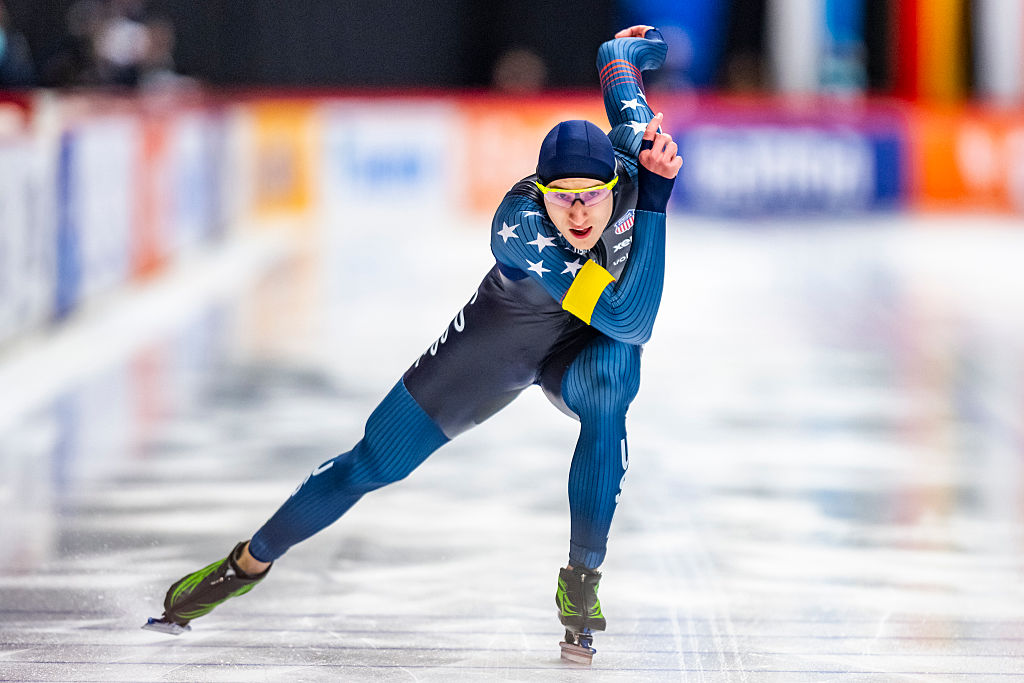
Jordan Stolz will represent the United States of America in Milan © ISU
Classical distances
All classical distances are skated in a time-trial format. Skaters race in pairs, with each athlete racing in a separate competition lane. The skaters switch from the inner to the outer lane at the backstretch of every lap.
The skater starting in the inner lane wears a white armband, and the skater in the outer lane wears a red armband.
When all pairs have completed their race, the skater with the fastest time wins. Timing is done automatically to an accuracy of one-thousandth of a second. Times will be displayed to one-hundredth of a second unless skaters are tied, and the tie can be broken at the thousandth-of-a-second level.
Team Pursuit
In Team Pursuit, there are three skaters in each team. The men skate a total of eight laps, and the women six. The result of the team is determined by the last finishing skater. The teams start at opposite positions at each side of the track, and there are no separate lanes.
Women's and men's team pursuit races will be skated over two days, with the quarter-finals on the first day, and the semi-finals and finals on the second.
The four fastest teams from the quarter-final races will advance to the semi-finals, and from the semi-finals onwards, it's a knock-out format. The winners of the semi-finals will race in the gold-medal final A race, and the losers of the semi-finals in the bronze-medal final B race.
Mass Start
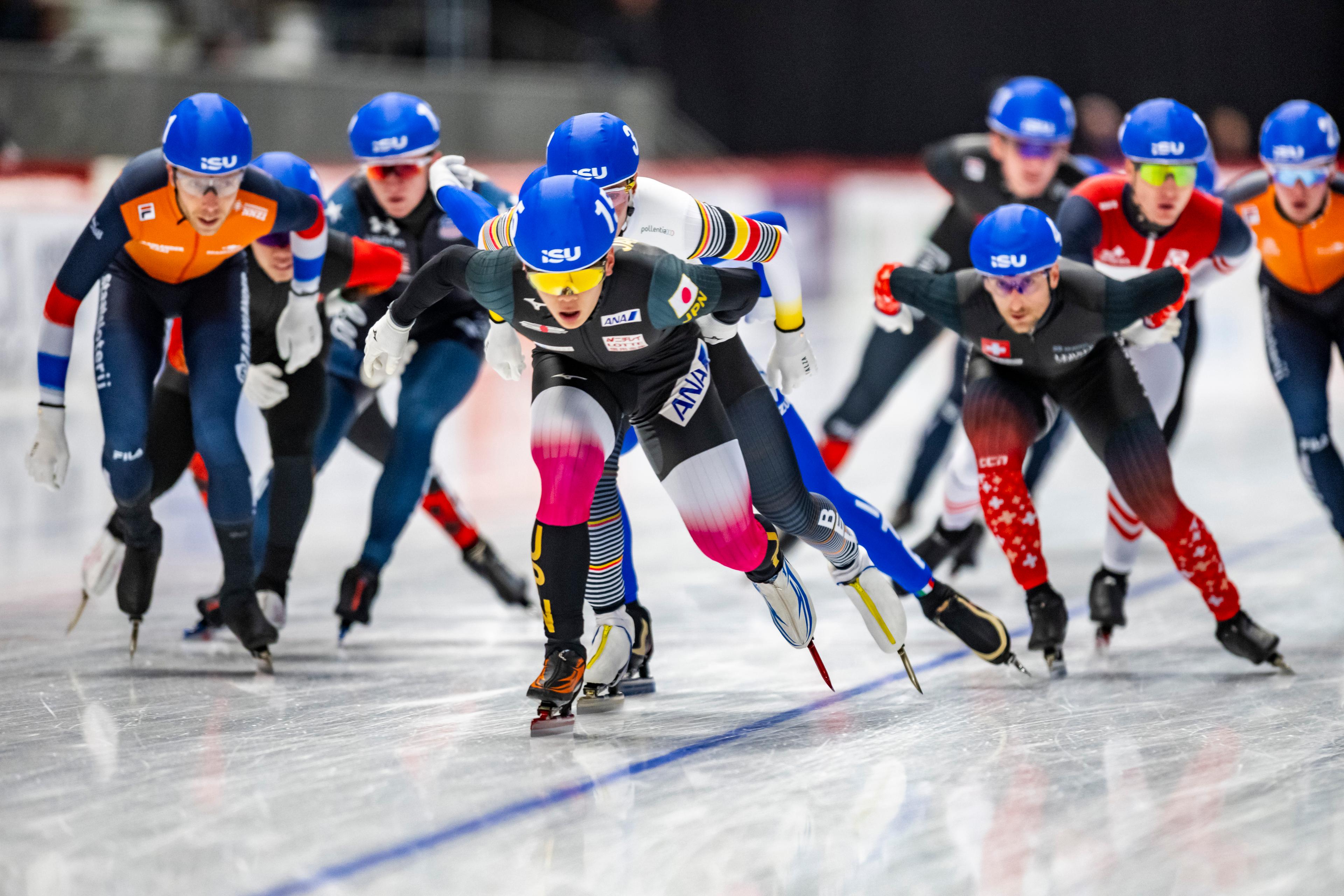
The Mass Start is a bunch race, with semi-final heats and a final, which will be skated on the same day. The top-eight ranked skaters from each semi-final qualify for the final. In addition, skaters may be advanced to the final based on the referee's decision. Each race comprises 16 laps with intermediate sprints after four, eight and 12 laps, and a final sprint at the finish.
The top-three from the final sprint will always be the overall podium, because the top-three skaters in the final sprint earn 60 - 40 – 20 points, while the first three skaters in intermediate sprints earn just 3 - 2 - 1 points. After the top three, the remaining skaters will be ranked according to their sprint points. Skaters without points will be ranked according to their order of finish in the final sprint.
A fan guide
- Long Track Speed Skating fans are very creative and bring banners and flags to support their favorites
- Loud cheering is much appreciated during the races, but please keep quiet at the start


