





SPEED SKATING
Speed Skating: The rules of the Backstretch
18 Feb 2026
For more information about Speed Skating in the Olympic Winter Games Milano Cortina 2026, please check here.
While all classical distances in Long Track Speed Skating are time trial events, the two skaters on the ice do interact with each other once a lap when they have to change lanes.
This exchange sometimes turns the backstretch into a contested area but the main guideline if there's any interference is that the outside lane always has priority.
Avoiding interference
The classical distances are always skated in pairs, with each athlete racing in a separate competition lane. The skater starting in the inner lane wears a white armband while the skater in the outer lane wears a red armband. So that both skaters cover the same distance, they switch lanes on the straight opposite the start-finish line called the backstretch.
Mostly, the exchange is smooth because there's enough room for one of the skaters to cross in front with the other skater crossing behind.
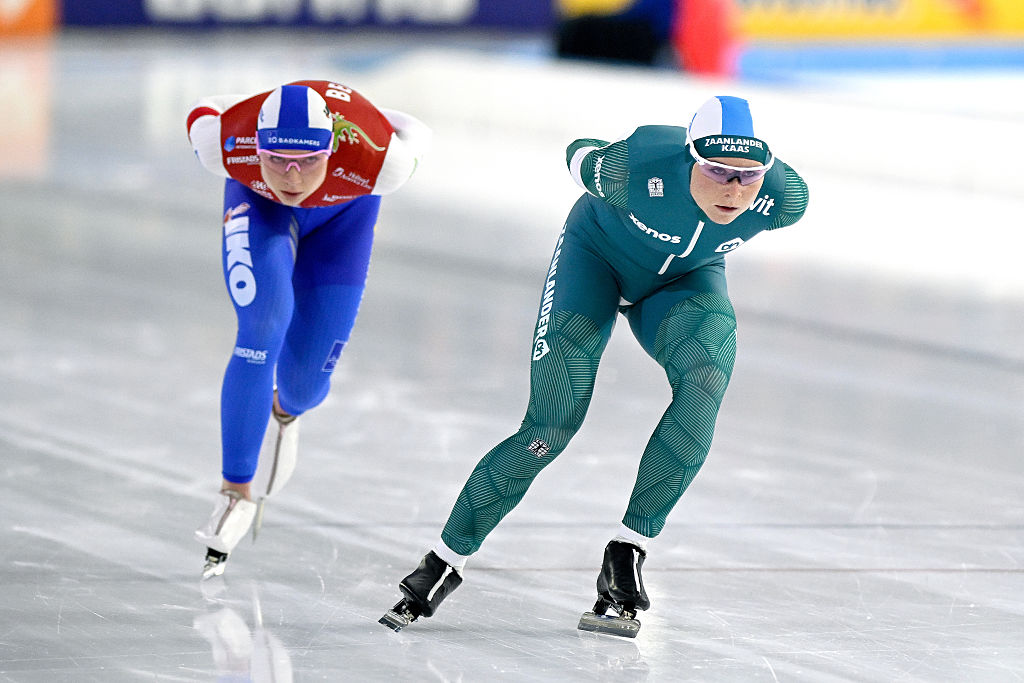
Marijke Groenewoud, right, crosses in front of Joy Beune on the backstretch at the Dutch Olympic trials in Heerenveen in December 2025 © Getty Images
On some occasions, however, two skaters are level when they arrive at the backstretch. In long distance races of 3000m and above, skaters often foresee this when they enter the corner before the backstretch, and they will adjust their speed a little to avoid interference at the backstretch.
Sometimes the inside lane skater will hold back a little to cross behind and take advantage of the draft, and sometimes he or she will accelerate a little to make sore there's enough room to cross in front.
When skaters are level, the skater entering the backstretch from the outside lane has priority. The reason is simple: when skaters are level at the backstretch, the one in the outside lane is always ahead in the race.
Collision course
In the 500m skaters hardly every get to the backstretch level, but in the 1000m and 1500m they do. Holding back to avoid interference is hardly possible in these fast-paced races where every second counts, and this sometimes leads to collision.
An example at the Olympic Winter Games Milano Cortina 2026 was the 1000m pair between Joep Wennemars (NED) and Lian Ziwen (CHN).
The Dutchman had been on course for a top time when his pairmate Lian Ziwen (CHN) didn't give way at the second backstretch, blocking the Dutchman. The two collided but both stayed upright. Wennermars had to hold back to cross behind his opponent and lost precious time.
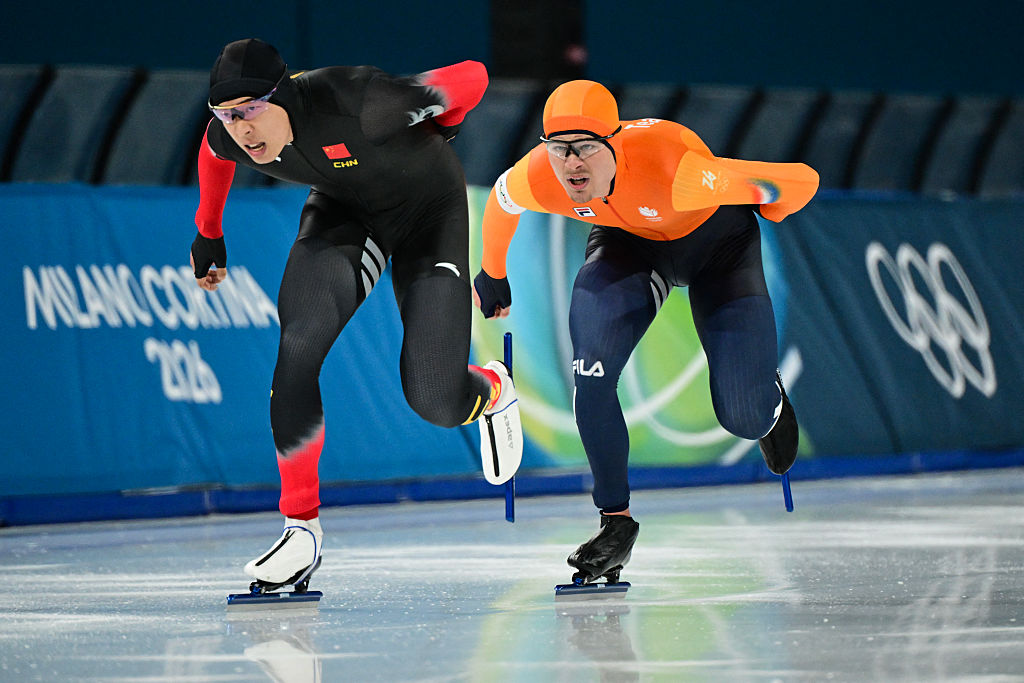
Lian Ziwen (CHN) fails to give way to Joep Wennemars (NED) despite the Dutchman occupying the outside lane © Getty Images
Lian was disqualified for not giving way to his opponent, who entered the backstretch from the outer lane.
Wennemars was granted a re-skate, but having to get back on the ice only half an hour after his first race, it was almost impossible for him to put in a similar effort. Much to his frustration, he eventually finished fifth.
The backstretch collision on the 1000m may be a warning for the skaters who are taking on the 1500m on Thursday (Men) and Friday (Women).
Taking advantage
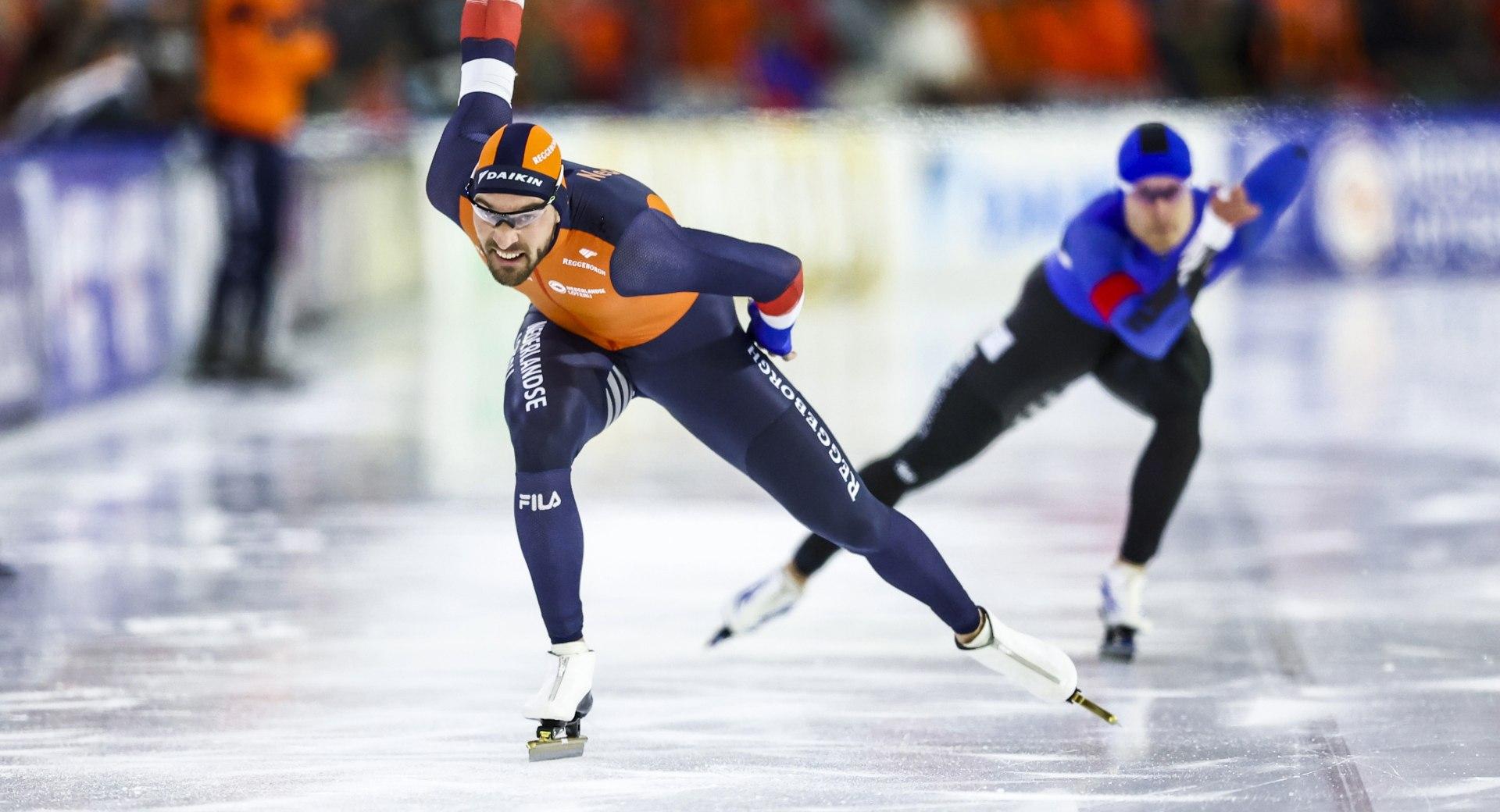
While the backstretch sometimes leads to exchange trouble, skaters can also take advantage of being at close quarters with their opponent. Double-Olympic 1500m Champion Kjeld Nuis (NED) - pictured top crossing over with Marten Liiv (EST) - always makes a study of his opponent, and is able to adjust his race strategy.
In the 1500m, skaters exchange lanes three times. If pair-mates have similar speed throughout the race, the one starting from the outside lane will cross behind at the first and the third backstretch, and the one starting from the inner lane will cross behind the second time they enter the change-up area.
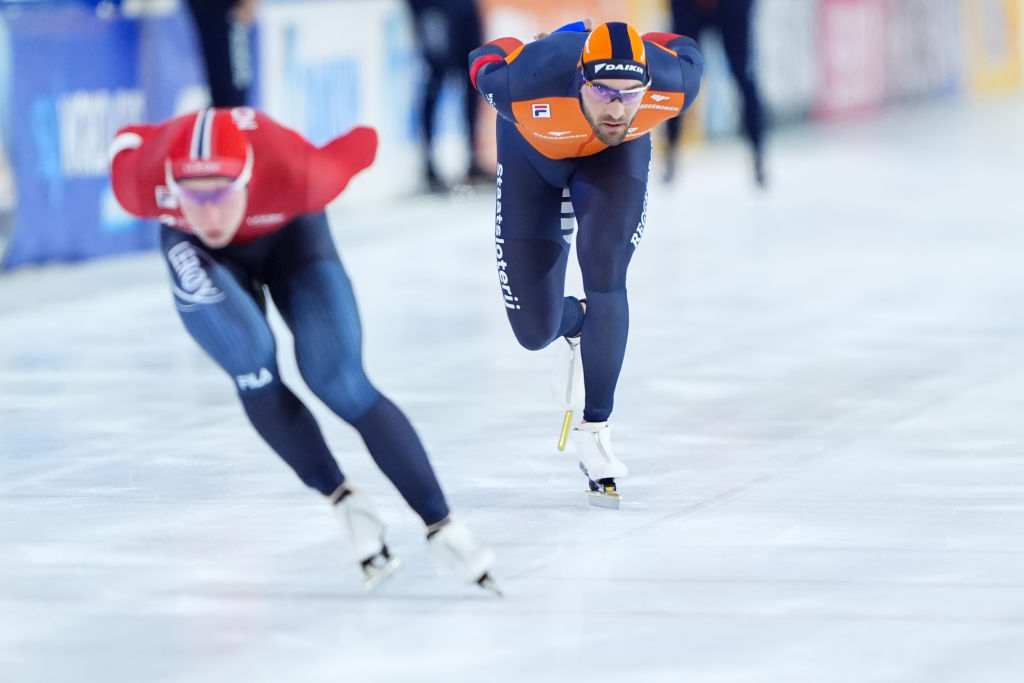 Kjeld Nuis (NED, right) uses the backstretch to size up Norway's Peder Kongshaug at an ISU World Cup race in February 2025 © ISU
Reflecting on possible opponents in his final Olympic 1500m race, Nuis said: "Starting outside against Ning Zhongyan (CHN) would be great. He's f***ing good. He starts very fast, we have a similar way of skating, and [starting outside] would give me two backstretches to chase him.
"Peder Kongshaug (NOR) would also be a good opponent, but with Ning, I can really battle up until that last cone [on the final backstretch]."


